
Why Venice for International Women’s Day 2026
Why International Women’s Day Still Matters and why we celebrate it together
International Women’s Day exists because progress matters - and so does pausing to mark it.
As we know, gender equality hasn’t been fully achieved anywhere in the world yet. But that’s exactly why this day isn’t just about problems (oh yes there are many!) it’s also about momentum, visibility, and collective strength.
What International Women’s Day stands for
At Girl Gone International we mark IWD in 300 cities across the world every year because at its heart, International Women’s Day is about:
recognising how far women have come
amplifying women’s voices and contributions
reminding the world that equality benefits everyone
and choosing to keep moving forward together.. farther together!
Why it’s still needed
Yes, massive challenges remain but here’s the hopeful part :
Progress does happen when women connect, collaborate and lead
Change accelerates when women are visible, supported and celebrated
Community and solidarity are proven drivers of long-term equality
International Women’s Day exists to shine a light on what’s possible, not just what’s unfinished.
Why we choose to celebrate it this way
At Girl Gone International, we believe something simple but powerful:
When international women come together across countries, cultures, and life paths something shifts.
We don’t mark International Women’s Day by standing apart or looking inward.
We mark it by coming together, sharing stories, laughing, eating well, walking beautiful streets, and remembering that we are not alone in this world.
Why Venice, why now
What better way to honour International Women’s Day than:
in an international city
with international women
many of us living lives shaped by movement, change, courage, and reinvention
This trip isn’t about fixing the world.
It’s about marking an important day by being present, connected, and joyful, together.
Because celebration is not separate from progress.
It’s part of how progress is sustained.
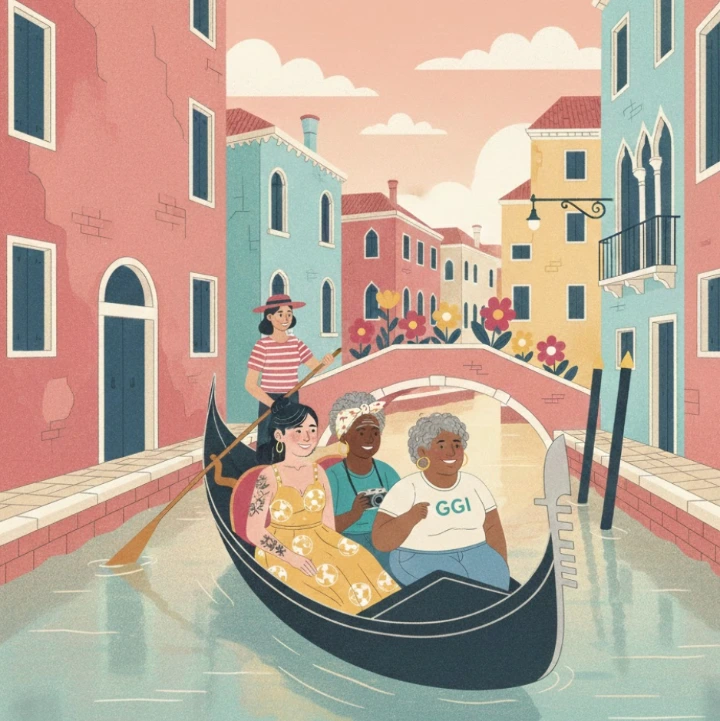
1) Because Venice has always been “a woman” in story and spirit
For centuries, Venice has been imagined as feminine - depicted in art as a majestic woman enthroned: serene, powerful, dignified.
A city born from water.
A city built on courage and adaptability.
A city that made beauty out of instability.
Venice rose from mud and uncertainty and became breathtaking anyway.
That’s a metaphor a lot of women understand in their bones.
2) Because Venice holds both the oppression and the turning points
One of the stories that stayed with me when I visited last is the 1776 edict banning women from cafés - women blamed, excluded, treated as a threat to public order.
And then, years later, the pushback.
Caffè Florian argued for the right to host women again not because society had suddenly become enlightened, but because women mattered. Their presence mattered. Their absence changed the culture and the economy.
That moment is IWD in miniature.
Women shut out.
Women blamed.
Women still essential.
Women return and reshape the room.
So when we meet in Venice, we’re not pretending history was romantic.
We’re honouring the reality of women’s place in society and the slow, gritty movement toward freedom.
(And yes, we will absolutely sit in cafés, drink something fabulous, and let that land.)
3) Because Venice is packed with women who refused to play their assigned role
This is a city that quietly produced generations of women who were wildly ahead of their time.
Women who didn’t just survive inside a male-run world but created, wrote, built, led, innovated, challenged, and shaped culture anyway.
Just a few of them:
Moderata Fonte
One of the earliest proto-feminist thinkers, she openly questioned whether histories written by men could ever tell the truth about women and wrote boldly about women’s worth, intelligence, and moral authority.
Veronica Franco
A celebrated courtesan and also a poet and intellectual who debated men in power, published her work, defended herself before the Inquisition, and refused to be reduced to a stereotype.
Sara Copia Sullam
A Jewish woman writing theology and philosophy in a Christian-dominated world, she insisted on her intellectual authority in public debate, despite facing double exclusion as both a woman and a Jew.
Arcangela Tarabotti
Forced into a convent as a child, she turned confinement into resistance, writing fiercely against the control of women’s bodies, minds, and lives, and calling out male dominance with fearless clarity.
Barbara Strozzi
One of the most prolific composers of her time she published and performed her own music in a world that told women to stay silent, proving creative authority didn’t belong to men alone.
Elena Lucrezia Cornaro Piscopia
The first woman in the world to earn a university degree, she was denied a theology doctorate simply for being a woman so she graduated in philosophy instead, changing academic history forever.
Elisabetta Caminer Turra
Founder and editor of Il Giornale Enciclopedico, she became the world’s first female journalist and editorial director, shaping Enlightenment thought while men debated it in cafés she was often excluded from.
Peggy Guggenheim
The “last dogaressa” of Venice, an art collector who made radical, modern art accessible to everyone, opened her home to the public, and reshaped Venice’s cultural future on her own terms.
Together, these women and so many others, show us something we still need reminding of:
Women have always been capable, intelligent, creative and visionary.
The world just wasn’t always willing to give them space.
Venice didn’t magically fix patriarchy but it did give women cracks in the walls.
And they used them.
4) Because Venice celebrates women’s labour not just women’s glamour
Yes, Venice has salons, silk, and spectacle.
But it’s also a city built on working women.
Lacemakers.
Bead-stringers.
Women who held entire industries together through invisible labour, unfair pay, endless hours and still created solidarity, humour, songs, and survival together.
There’s a Venetian phrase I love:
“Semo tute impiraresse.”
We are all pearl-stringers.
It says: we know what it is to work, to carry, to endure and we do it together.
That feels very Girl Gone International.
5) Because Venice can hold complexity and so can we
Venice has always been a crossroads. East and West. Old and new. Tradition and rebellion. Belonging and exile.
International Women’s Day isn’t simple either.
It’s joy and anger.
Pride and grief.
Celebration and unfinished business.
Venice doesn’t flinch from contradiction and that makes it the perfect place for real conversations, real connection, and real reflection.
6) Because this trip is a living tribute, not a lecture
We’re not going to Venice to do a “women’s history tour.”
We’re going to gather as women in a city shaped by women’s lives and let the place hold the meaning while we live it.
Walking through beauty built on centuries of women’s footsteps.
Sitting in spaces that once tried to keep women out.
Talking, laughing, reflecting, resting.
Celebrating how far we’ve come and naming what still needs to change.
Because IWD is both things at once:
A celebration of progress.
And a refusal to forget the work still ahead.
And why Venice is personal for me
There’s one more reason Venice matters to me.
In the summer of 2017, I read The Unfinished Palazzo. At the time, I was coming out of a long recovery period in my life, years after divorce following an abusive marriage.
I was living in a run-down, four-storey, rent-controlled house in Spain. There was very little money in it, but somehow it became a refuge for so many people. Friends passing through. People who needed somewhere safe. Long conversations on the stairs. Shared meals. A lot of holding and being held.
I had no clear plan.
No idea what my life was supposed to look like next.
There were deep bouts of depression. Long stretches of feeling lost.
And yet, strangely, it was one of the most creative eras of my life. I felt that everything was still possible. That I was rebuilding. That I was slowly finding my way back to myself.
That book landed exactly where I was. And when I could, I went to Venice.
Being there felt like part of my recovery.
Walking through a city that was visibly imperfect, fragile, unfinished and still overwhelmingly beautiful helped something settle in me. It made me realise that mess wasn’t a failure. It was natural. That beauty doesn’t come after the chaos, it often rises from it.
Venice taught me there doesn’t always have to be an end destination. That some eras of life - the feeling, the healing, the people, the being lost - are moments in themselves. Not something to rush through or “fix”, but something to respect.
That book taught me something I’ve never forgotten:
Unfinished doesn’t mean broken.
Sometimes it just means alive.
And yes, I’m still living in my unfinished palazzo. For now.
So choosing Venice for International Women’s Day feels quietly full-circle. Not because life is neat or resolved but because it’s honest. Becoming. Open.
Venice, IWD 2026
If you’re craving:
a trip that actually means something
friendships that feel natural, not forced
a women-only space where you can breathe (trans women are women and NB folk are welcome too)
an International Women’s Day that feels real, not symbolic
a weekend that leaves you more connected, more grounded, more alive
I think you’re going to love Venice.
And I’d really love you to be there with us.
Anne Scott,
Gone International and Girl Gone International Founder